

The Amazing Chemistry in Your Home - Lenka Karpiskova - ★★★★
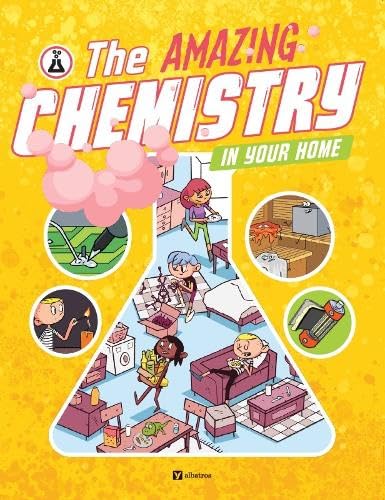
AUTHOR: Lenka Karpiskova
GENRE: Children's Nonfiction, STEM.
SERIES: Science All Around Us, #3
PUBLICATION DATE: January 27, 2026
RATING: 4 stars.
In a Nutshell: A fully-illustrated nonfiction work about how we encounter chemistry in our homes. Aimed at middle-graders and teens. Recommended.
This book is a part of a series with three standalone books. I recently read Book One: ‘The Awesome Physics in Your Home’ and found it quite impactful and enlightening. But as Book Two was also about Physics (The Awesome Physics in Your City), I decided to change subjects and try Book Three instead with Chemistry as the focus.
Kids are often told in school that cooking is the most common chemistry, but this book explains how chemistry in our daily lives goes far beyond the kitchen.
Just as in the Physics book, the content is divided not by chemical concepts but by the parts of the house such as living room, kitchen, bedroom, bathroom and so on. This ensures that we get a practical view of several routine activities where chemistry is found. It’s great that the book also covers the uncommon parts of a house such as laundry room, porch, and workshop. This extends the scope of the topics. For instance, the chapter on ‘Porch’ includes balloons and fireworks. Clever!
I like how the book tackles things that are actually handled by or familiar to children even if the explanations might not be familiar. There are so many things we do at home without even knowing that there’s chemistry behind it. Why does cutting onions make us cry? Why are spatulas for nonstick pans made of wood and not metal? Why should kids not drink coffee? Many such questions and more are answered herein. If you think that these all are just common-sense matters and not chemical concerns, try these… How is oil a liquid but butter a solid when both are fats? Why do balloons deflate after some time no matter how tightly we tie the knot? When a cereal is said to ”contain iron”, are we eating the same iron as the metal?
The content is neatly arranged in logical sections, and many concepts come with simple experiments that children can do at home alone or under supervision of an adult. A great way of implementing practical learning.
Given that the target age is middle-grade to teens, the book doesn’t begin with the basic essentials. It presumes a certain familiarity with some chemical concepts. Of course, it does explain some of the terms, but overall, the content would work better for those who already have a foundational understanding of chemistry. A few terms might be too difficult for younger middle-graders, but nothing so difficult that cannot be looked up online or explained by an adult. There is a brief glossary at the end, but it contains a generalised background of the terms than the definition/meaning.
The illustrations work well in conjugation with the content. At the same time, they are also independent of the content a few times. As such, both the text and the illustrations have to be focussed on to get a proper understanding of the concept. Those who do an either/or with the text and illustrations while reading nonfiction STEM works won't get the full benefit of the information.
Recommended to science nerds as well as to those interested in seeing the practical applications of chemistry without being bogged down by (too many) technicalities. This ought to be a great addition to a classroom/school library as well.
My thanks to Albatros Media for providing the DRC of “The Amazing Chemistry in Your Home” via Edelweiss Plus. This review is voluntary and contains my honest opinion about the book.


Comments
Post a Comment