

Isabella Nagg and the Pot of Basil - Oliver Darkshire - ★★.½
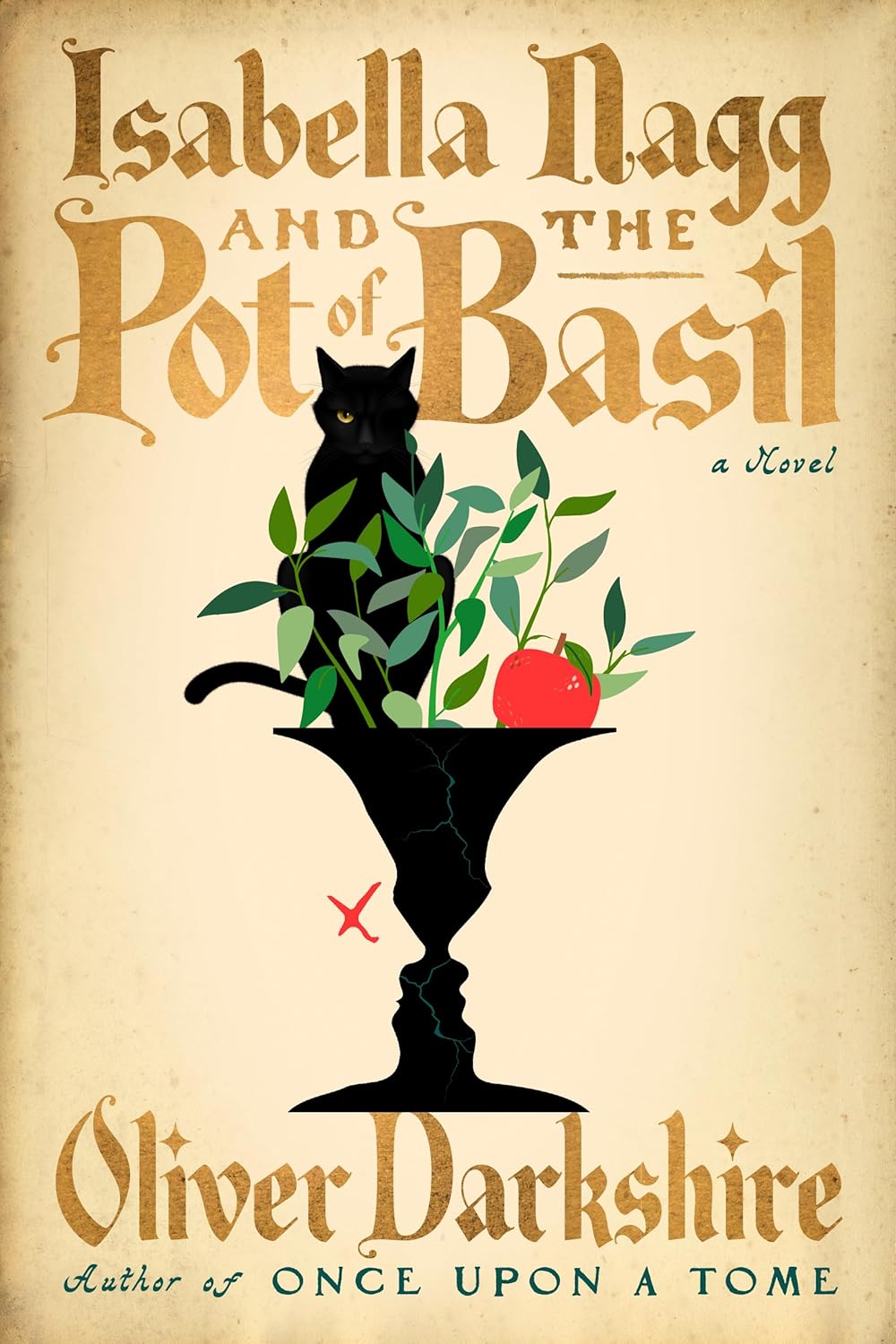
AUTHOR & NARRATOR: Oliver Darkshire
SERIES: Household Gramarye #1
GENRE: Cozy Dark Fantasy
PUBLICATION DATE: May 13, 2025
RATING: 2.5 stars.
In a Nutshell: A darkish cozy fantasy. Quirky, but often feels forced in its humour. Minimal cozy vibes. Whimsical human and nonhuman characters. Mild Discworld vibes. I had to read it twice because the audio version just didn’t click with me. First of a planned series. Not a book that will work for all, but it might find a niche audience.
Plot Preview:
Isabella Nagg lives in the sad little village of East Grumsby. With an unappreciative husband, snide neighbours, and recalcitrant farm animals, Isabella has only a pot of basil to talk to (even if it doesn’t speak back) while she handles all her chores. One day, when the useless Farmer Nagg returns with a spell book he stole from the local wizard, Isabella wonders if she could use magic to ease at least a part of her life. As Isabella ventures on this new magical path with only a grouchy cat-like creature for company, she discovers that magic can indeed change the world, but not necessarily for the better. Thus begins a crazy ride filled with talking donkeys, fruit-selling goblins, heinous businesswomen, and of course, a sentient pot of basil.
The story comes to us in the third-person perspective of a multitude of characters.
While requesting this book, I wasn’t aware of Oliver Darkshire or his bestselling memoir titled “Once Upon a Tome: The Misadventures of a Rare Bookseller”. I took this novel mainly for its whimsical cover and title. This is the author’s debut novel, rooted in one of the short stories of the Decameron, Boccaccio’s short story collection from the 14th century. (John Keats has also written a poem on this story. You can read it HERE if you wish.) I haven’t not read the original in any form, so I have no idea whether this novel is faithful to it. But I do appreciate the unusual base source; retellings based on fairy tales and Greek mythology are getting too common!
Unfortunately, this book didn’t exactly turn out to be my pot of basil… errrmm… my cup of tea. I was quite relieved to have access to both the audio and digital versions of this cozy fantasy. When I heard the audiobook, it just didn’t work for me. So I reread the whole book from the digital copy. This turned out to be a slightly better experience, even though it meant I effectively spent about ten days on this book. 🤦🏻♀️
Bookish Yays:
🌿 Isabella as the heroine with “The Common Sense”. A fabulous character who knows her situational constraints and yet can’t stop dreaming about and trying for a better future. A great eponymous heroine.
🌿 Henric Nagg, for being so typical of the male species (for the most part). I like that he wasn’t an outright villain nor a good-hearted buffoon. His casual misogyny rings utterly true.
🌿 The non-human characters, especially the cat-like Grimalkin who helps Isabella in her magic and Bottom the Donkey who is more like Eeyore from the ‘Winnie the Pooh’ world than like Donkey from Shrek. The pot of basil also deserves mention, though I cannot elaborate on the reasons for the sake of spoilers.
Bookish Okays:
🌱 The “Household Gramarye”, the magical book that Isabella uses. It could have been an alluring grimoire because of the way it is described and its magic potential. But we barely see it in action. I wish there had been more spells explored.
🌱 The whimsical feel of the book, accentuated by modern-day words juxtaposed with historical situations. At the same time, it is not exactly ‘cosy whimsical” because there are several dark scenes.
🌱 The humour, strongly British in tone so it’s more wry and understated. This works well at the start where the humour comes in regular doses. But after a point, the humour seems to have been abandoned in favour of a mostly serious, somewhat morbid storyline.
🌱 The interlude chapters, containing journal-like details about the various creatures Isabella encounters on her new magical path. This is interesting for a while, but soon feels like interruptions to the main plot, especially as the background of these creatures barely has an connection to their present behaviour. I skipped all these chapters on my second round with the digital edition.
🌱 The convoluted multi-POV approach, with the storyline shifting characters as and when it feels like. After a few chapters, the headjumping becomes too much.
🌱 The ode to other folk tales and fairytales popping in subtly at random. I enjoyed whatever clues I could detect, but I am fairly sure I missed out on a lot of clues as they aren’t at all obvious. My favourite was the indirect homage to Hans Christian Andersen’s ‘The Tinderbox’ with its three hounds. I had read this story in my childhood and had forgotten its existence! I barely remember anything about it except for the three dogs with saucer-sized eyes. I will read it next for old times’ sake!
Bookish Nays:
🌵 Too many concocted new words. This might not have been so distracting had they been spelt the more traditional way. The audio was a terrible way of trying to figure out the words and spellings. (More on this below.)
🌵 Too many subplots. Combined with the multi-POV approach, it is tough to understand where the plot is going, until everything suddenly comes together somehow. I wish it hadn’t been so haphazard in its structuring.
🌵 Too many footnotes. They contain mostly useless facts/elaborations about random things mentioned in the story. Such a waste of time, especially as some of them run quite long! A note should stay at note length and not reach a para!!! I skipped the footnotes in the second half of the digital edition as none of them had any bearing on the plot, and I don’t think it affected my comprehension at all.
🌵 Too slow-paced.
🎧 The Audiobook Experience:
The audiobook, clocking at 6 hrs 52 min, is narrated by the author himself. I don’t know how to describe the issue I had with his narration. His enunciation is good enough, and he does a great job voicing some of the special characters such as the donkey and the pot of basil. But somehow, I kept zoning out of the audiobook and never felt deeply involved with the content. I think one hurdle was the constant shifts in POV; it made the listening feel jumpy.
Further, some words were very tough to figure out. For instance, Gramarye (spelling learnt from the digital version) is pronounced ‘grammar’. My head was initially befuddled at how a Grammar book kept throwing up magical spells! 🙆🏻♀️🤦🏻♀️
Plus, if Isabella is supposed to be the main character and most of the events happened around her, a female narrator might have made better sense.
Until I read my digital copy, I didn't even realise that the book had footnotes. So I tried out immersion reading for a few chapters. Turns out, the audio doesn't contain all the footnotes in the novel! All the unimportant ones, i.e. those that don't directly affect the plot, are left out. (Which makes me wonder why they're even included in the first place. Are they just ad-hoc additions to add further eccentricity to the narrative?) Those footnotes that help in character detailing or plot development are included in the audio, being read at the exact point where they appear in the actual narrative. This leads to a few random segues in the audio version. At no point are these indicated as being 'footnotes', nor are they read by another narrator (as the footnotes in R.F. Kuang's 'Babel' are.) Basically, unless you know that the book has footnotes, you will be blissfully unaware of their presence if you opt for the audio version.
Overall, this is not that great a cozy fantasy but a decent dark fantasy. The audio version I had wasn’t tempting enough for me to stay focussed. And the digital version had extensive yet unrelated footnotes and a terribly slow pacing. If you wish to read this, it better be through a physical edition.
Those who enjoyed this book more will be happy to learn that it is the first of a planned series of standalone stories and the next title is coming in 2026. I hope those who continue with the series find it as satisfying as they expect. I don’t think it is for me, though.
Recommended to those who enjoy Brit humour and dark fantasy. This isn't a book that takes itself too seriously, and you can do the same while reading it to enjoy it more.
My thanks to W. W. Norton & Company for providing the DRC and to Dreamscape Media for providing the ALC of “Isabella Nagg and the Pot of Basil” via NetGalley. This review is voluntary and contains my honest opinion about the book.


Comments
Post a Comment